Noted public anthropologist David Bond appointed to lead Georgetown’s Center for Environmental Justice
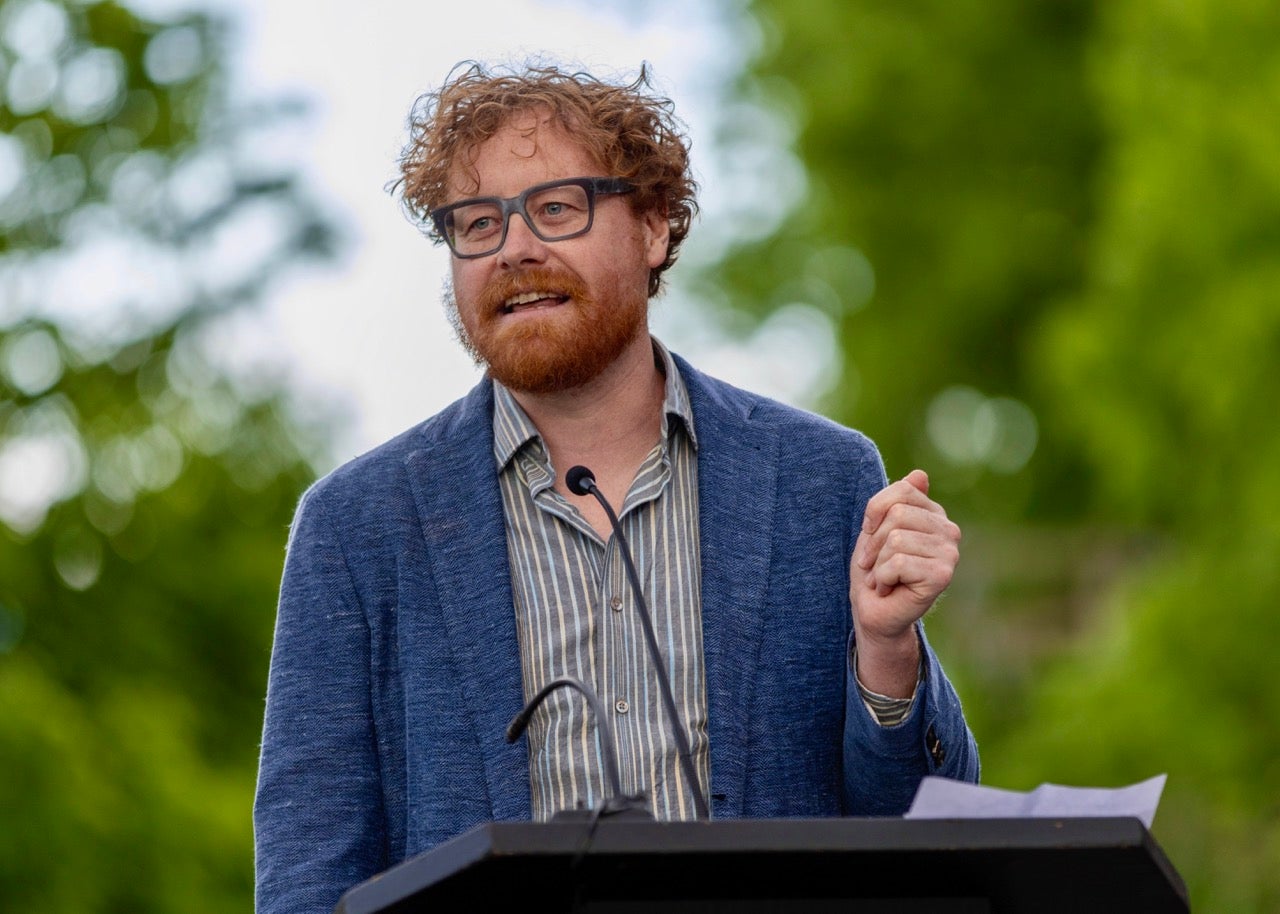
Scholar, teacher, and activist David Bond, PhD, has been appointed director of Georgetown University’s Center for Environmental Justice (CEJ), which is housed at the Earth Commons, Georgetown’s Institute for Environment and Sustainability. Bond, an award-winning anthropologist whose research, teaching, and service is deeply committed to the pursuit of environmental justice, arrived at Georgetown in August 2026 and will serve as an associate professor in both Earth Commons and the Department of Anthropology.
We must amplify the frontline voices of environmental justice in our classrooms, in our nation’s capital, and in the wider world.
A prominent voice in the fight against the destructive effects of fossil capitalism, Bond is an expert at integrating rigorous scholarship and experiential learning into the work of public anthropology, which the American Anthropological Association (AAA) recognized when it awarded him its 2022 New Directions Award for “work that presents anthropological perspectives to publics beyond the academy across diverse forms of media, with methodological rigor and ethical engagement.” Bridging scholarship and public media, in addition to authoring over 25 academic articles and receiving over $4 million in grants, his scholarship has been featured in the Associated Press, Bloomberg News, The Guardian, Inside Climate News, The Intercept, NPR, The New Yorker, Politico, The Wall Street Journal, The Washington Post, and others.
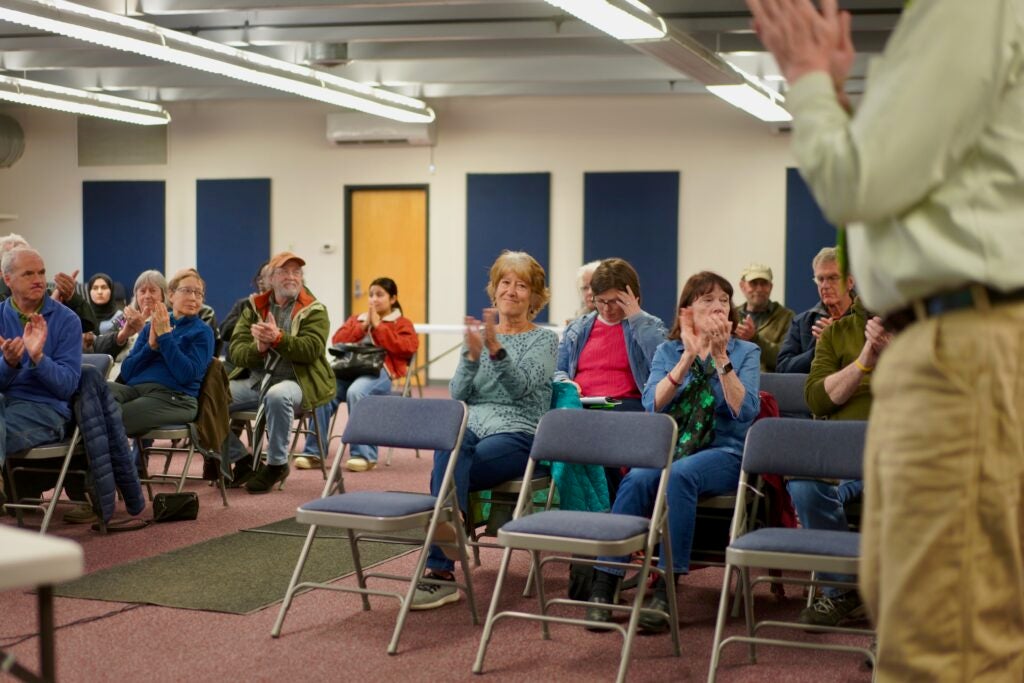
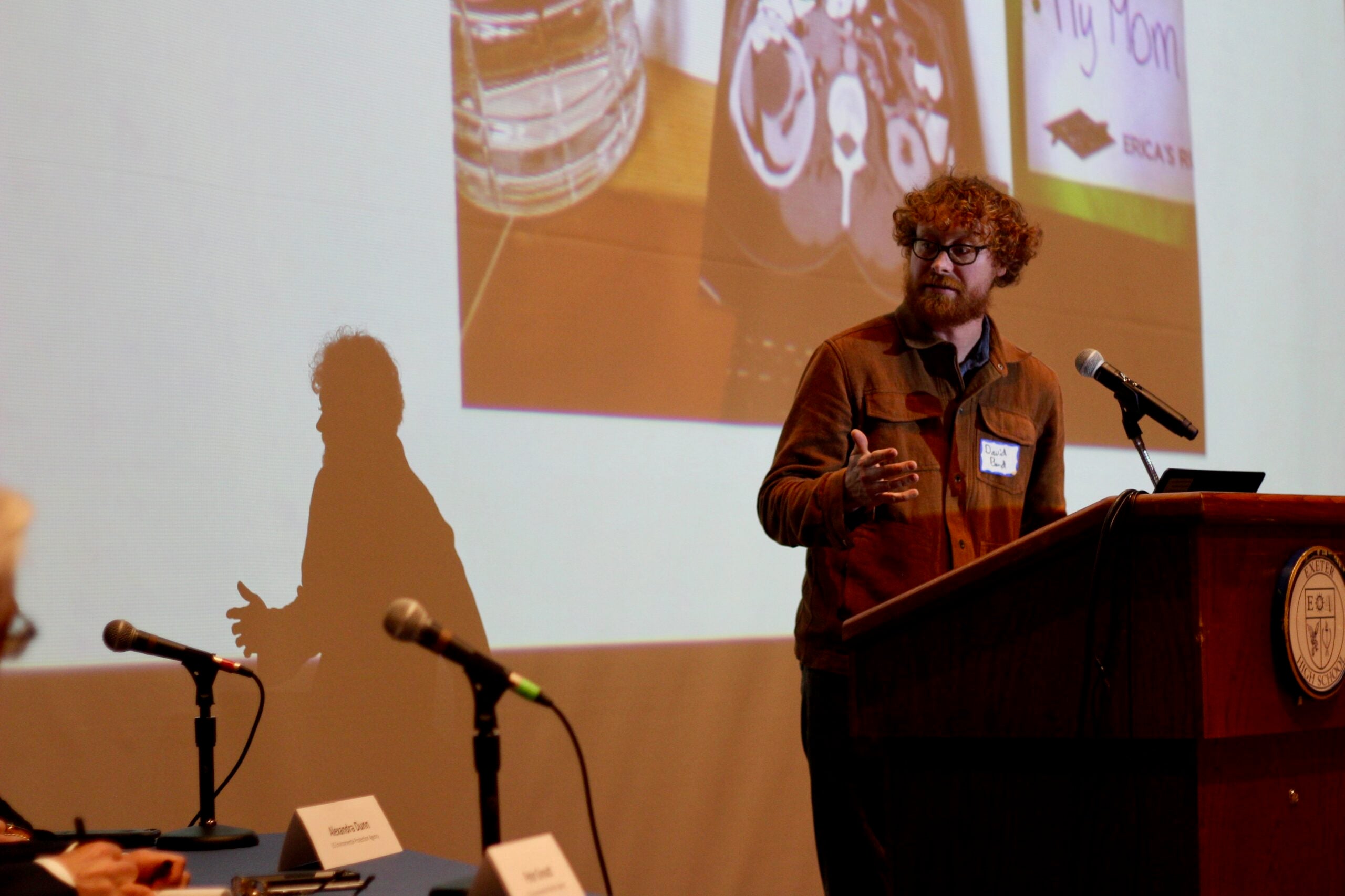
At a PFAS community information session at Bennington College in 2025. Photo: David Bond.
“David brings exactly the combination we were looking for in a Director for the Center for Environmental Justice,” says Peter Marra, Dean of the Earth Commons. “He’s an outstanding scholar, an interdisciplinary thinker, an experienced academic leader, and someone whose work is deeply engaged with communities experiencing environmental harm. As a cultural anthropologist, he studies fossil fuels, toxicity, environmental racism, climate change, and how communities respond to environmental disruption—all work that crosses environmental science, history, politics, economics, ethics, and justice. David’s scholarship has also consistently moved beyond the academy, including collaborations with frontline communities and work that has informed public debate, advocacy, and policy.”
Bond’s passion for his work is palpable. “From fenceline neighborhoods to blistering urban heat domes to landscapes besieged by industrialized violence, environmental justice is an intuitive language for the dispossession that defines our contemporary, and what we might do about it,” Bond says. “We must amplify the frontline voices of environmental justice in our classrooms, in our nation’s capital, and in the wider world, and I look forward to continuing to do so here at Georgetown.”
David’s scholarship has also consistently moved beyond the academy, including collaborations with frontline communities and work that has informed public debate, advocacy, and policy.
Peter Marra, Dean, the Earth Commons—Georgetown University’s Institute for Environment & Sustainability
Teaching by example
Bond earned his PhD in Cultural Anthropology from the New School for Social Research in 2013. His scholarship has been published in leading journals such as American Ethnologist, Comparative Studies in Society and History, Cultural Anthropology, and Radical History Review, and in 2024 his first book, Negative Ecologies: Fossil Fuels and the Discovery of the Environment received the AAA’s Robert B. Textor and Family Prize for scholarship redefining anthropology. He had invited fellowships at the Institute for Advanced Study at Princeton University (2018-19 & 2022-23).
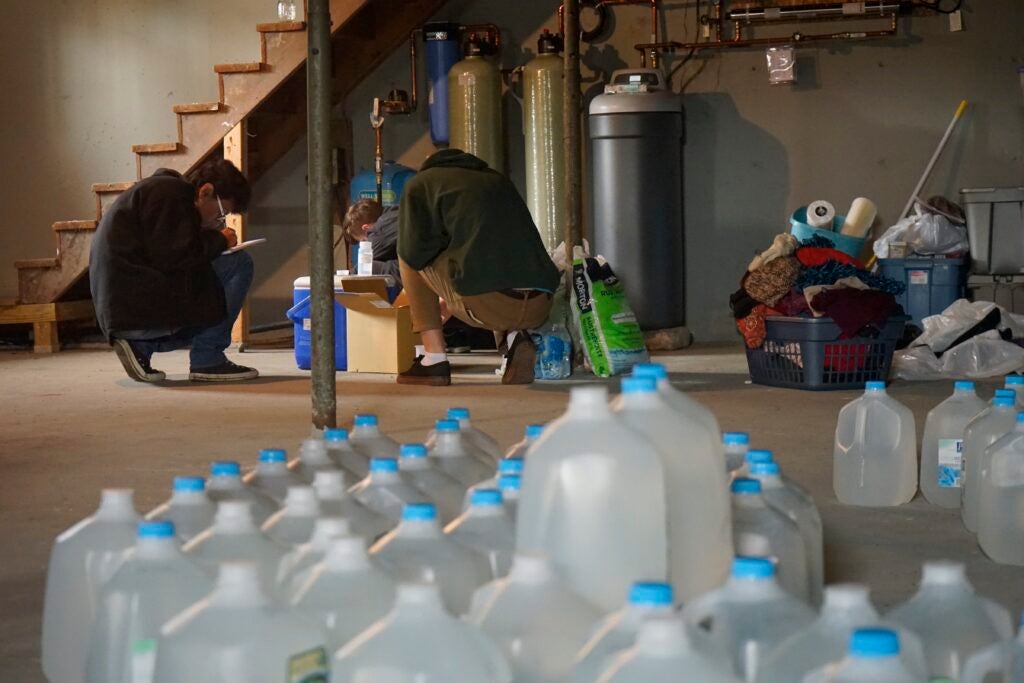
Students sampling for Perfluorooctanoic acid (PFOA) project at Hoosick Falls, NY in 2018. Photo: David Bond.
Bond’s approach to teaching is grounded in his ethical and intellectual commitments. “I believe in centering marginalized communities, while bringing the analytical and pedagogical talents of the university into substantive conversation with community struggles for justice,” he explains. In the classroom, this translates into involving students in the practice—as well as the study—of environmental and social justice. Bond taught at Bennington College in Vermont from 2013-2026, where he helped direct the Center for the Advancement of Public Action, an institute designed to connect classroom learning with urgent, real-world problems including PFAS contamination, climate change, and the housing crisis. He also co-founded Bennington’s Prison Education Initiative, which provides liberal arts programming and college courses to incarcerated students at the maximum-security Great Meadow Correctional Facility in New York.
Bond’s many projects and initiatives have included offering free science classes on PFAS to impacted communities; organizing health surveys to gather a community’s knowledge of its own health; organizing environmental monitoring systems to document air and water pollution in communities; documenting what he has described in his work as “profitable disregard” which locates hazardous industries in marginalized communities; hosting dozens of press conferences with community leaders to help broadcast their stories and their struggles; and testifying in neighborhood gatherings, town meetings, and statehouse hearings. In a local newspaper story on student involvement in combating the housing crisis, a student working on the issue asserts that taking courses on housing with Bond was “one of the most formative of his college career.”
A collaborative and transformative approach
As the new director of the Center for Environmental Justice, Bond will continue to develop and form its mission of enhancing and elevating multidisciplinary, interdisciplinary, and transdisciplinary initiatives that prioritize diverse perspectives to advance environmental justice scholarship and culture throughout the university and beyond. The Center, whose founding in 2021 was inspired by the encyclical Laudato Si’ to serve as a bridge between Georgetown’s work in ethics and its commitment to environment and sustainability, moved into its home at Earth Commons in 2024. “David is a builder,” Marra says. “I’ve been struck by his intellectual curiosity, his energy, and his genuine interest in other people and their ideas. He is already reaching across Georgetown to build relationships and imagine what the Center can become, and I think faculty, students, and community partners will find him an exciting and generous colleague with whom to work.”
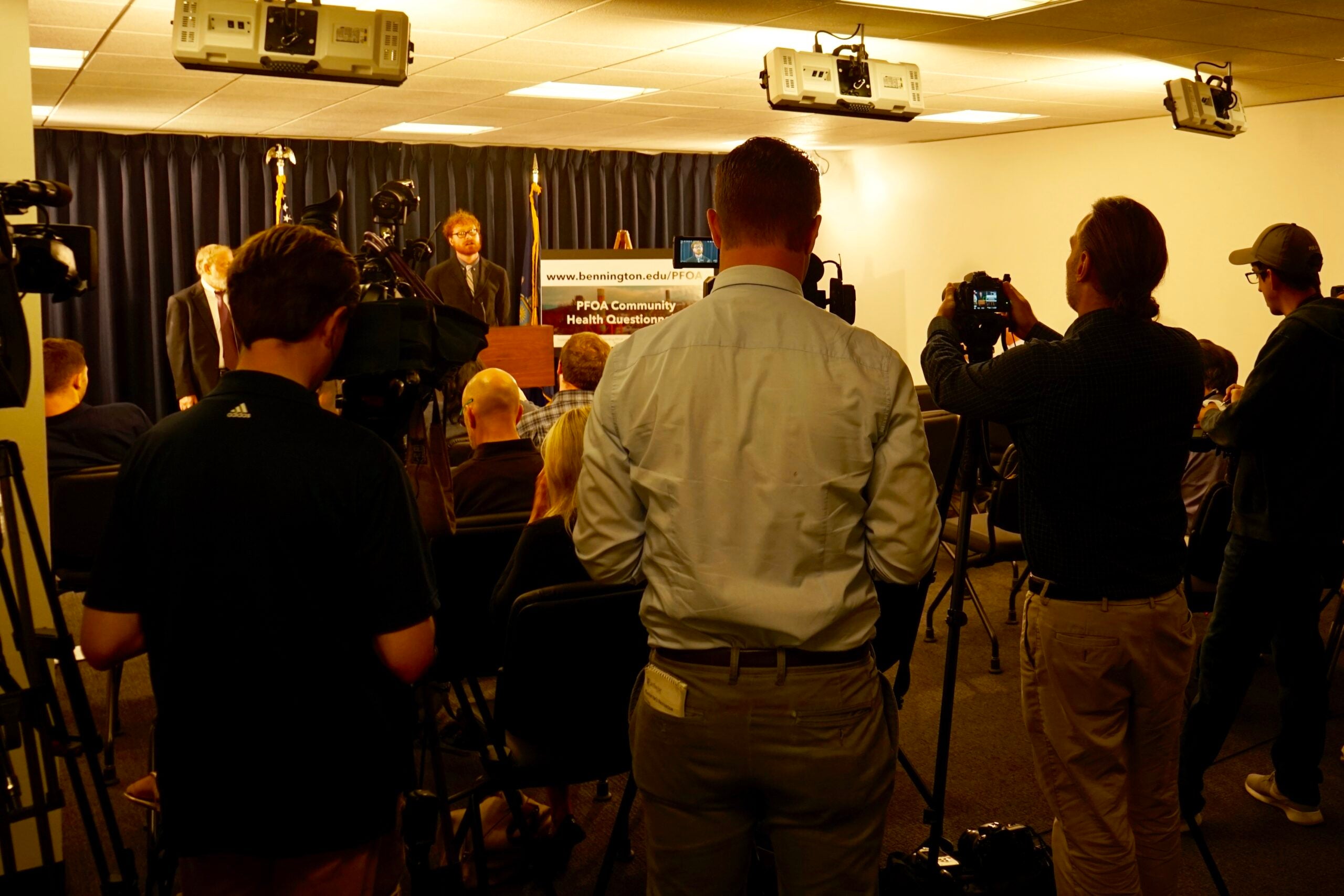
David Bond at press conference for launch of PFAS health questionnaire in Albany in 2018.
Slide2 of 3
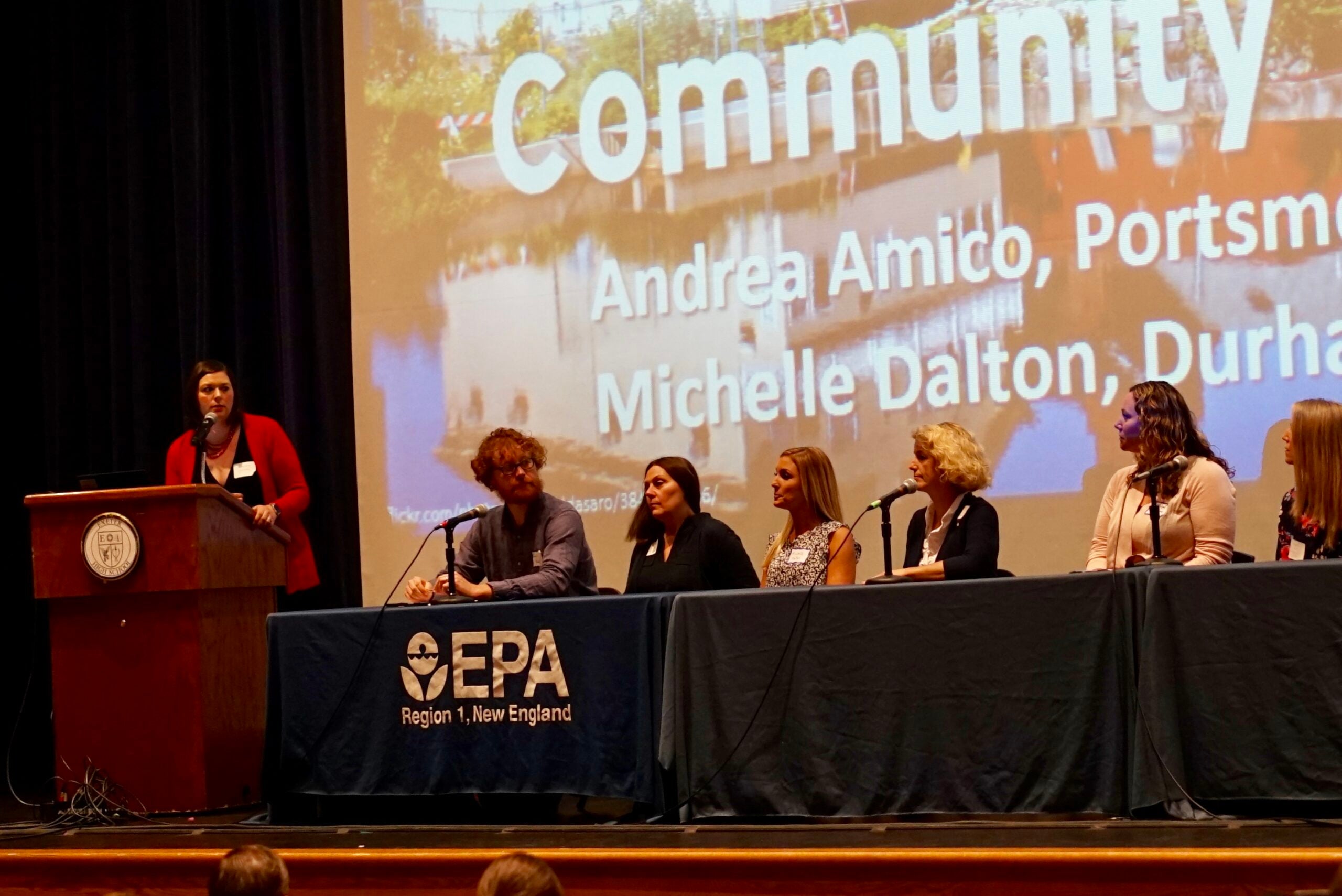
David Bond speaking at EPA PFAS Summit in New Hampshire in June of 2018.
Slide3 of 3
David Bond testifying to EPA at regional PFAS conference in New Hampshire in 2018.
End of carousel collection.
Colleagues agree. “David is an energetic and passionate educator with a deep well of experience connecting classrooms and communities around critical issues of Environmental Justice,” observes Randall Amster, Teaching Professor and Co-Director of the BS in Environment & Sustainability. “The field itself addresses fundamental questions of equity, as the benefits and burdens of current and emerging methods of production and distribution are considered, and David brings a wealth of theoretical insights and practical engagements to these fundamental inquiries. All of this positions David very well to help galvanize an area that has been ascending within many fields in recent years (including health, social sciences, law, and the arts) and promises to further elevate our mission to care for one another and our common home equally.”
Bond appreciates Georgetown’s ethos as a community of scholars and teachers who take issues of justice seriously. “Environmental justice is nothing new for Georgetown, and the Center for Environmental Justice introduces a new meeting ground for the great work already underway,” Bond says.
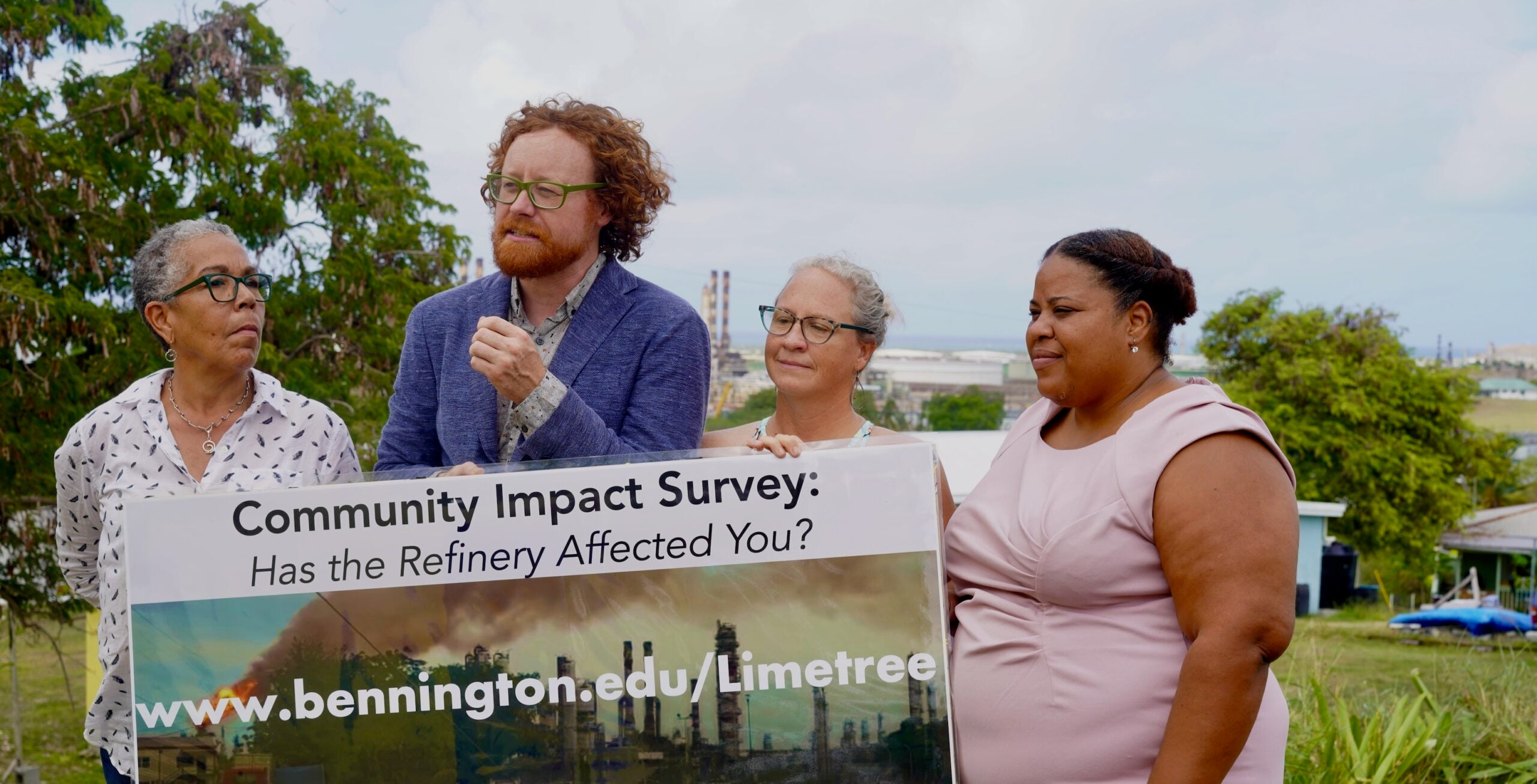
Bond at press conference for launch of community impact survey in St Croix, USVI in June 2021.
As director of the CEJ, Bond will work closely with the directors and faculty of three other ethics-focused centers who together form the Emergent Ethics Network at Georgetown: the Center for Digital Ethics, the Kennedy Institute of Ethics, and the Pellegrino Center for Clinical Bioethics. The Network’s charge is to build “a cross-campus community of scholars and students, in a transformative approach to ethics defined by robust engagement and collaboration across disciplines, in pursuit of lasting solutions to pressing problems.”
Bond’s affinity for this mission was apparent at a recent gathering of the Kennedy Institute of Ethics and the Pellegrino Center for Clinical Bioethics, at which he described to several bioethicists his involvement in efforts to shut down the Limetree Bay Refinery in St. Croix, VI, after its expedited, largely unregulated reopening in 2020 led to severe health and environmental consequences for local residents. He explained that oil was “literally raining down” on neighborhoods where many families get their drinking water from rain cisterns. Bond joined with community leaders to document the resulting harms, and demand that elected officials, corporate executives, and federal agencies recognize the disaster and bring the resources necessary to repair the damages. As many well-heeled interests labored to downplay and dismiss resident’s complaints, Bond’s research revealed consistent and startling patterns of harm in the neighborhoods downwind of the refinery. His research helped bring the disaster into the national news, and eventually the EPA shutdown the refinery for posing an imminent threat to public health on St. Croix.
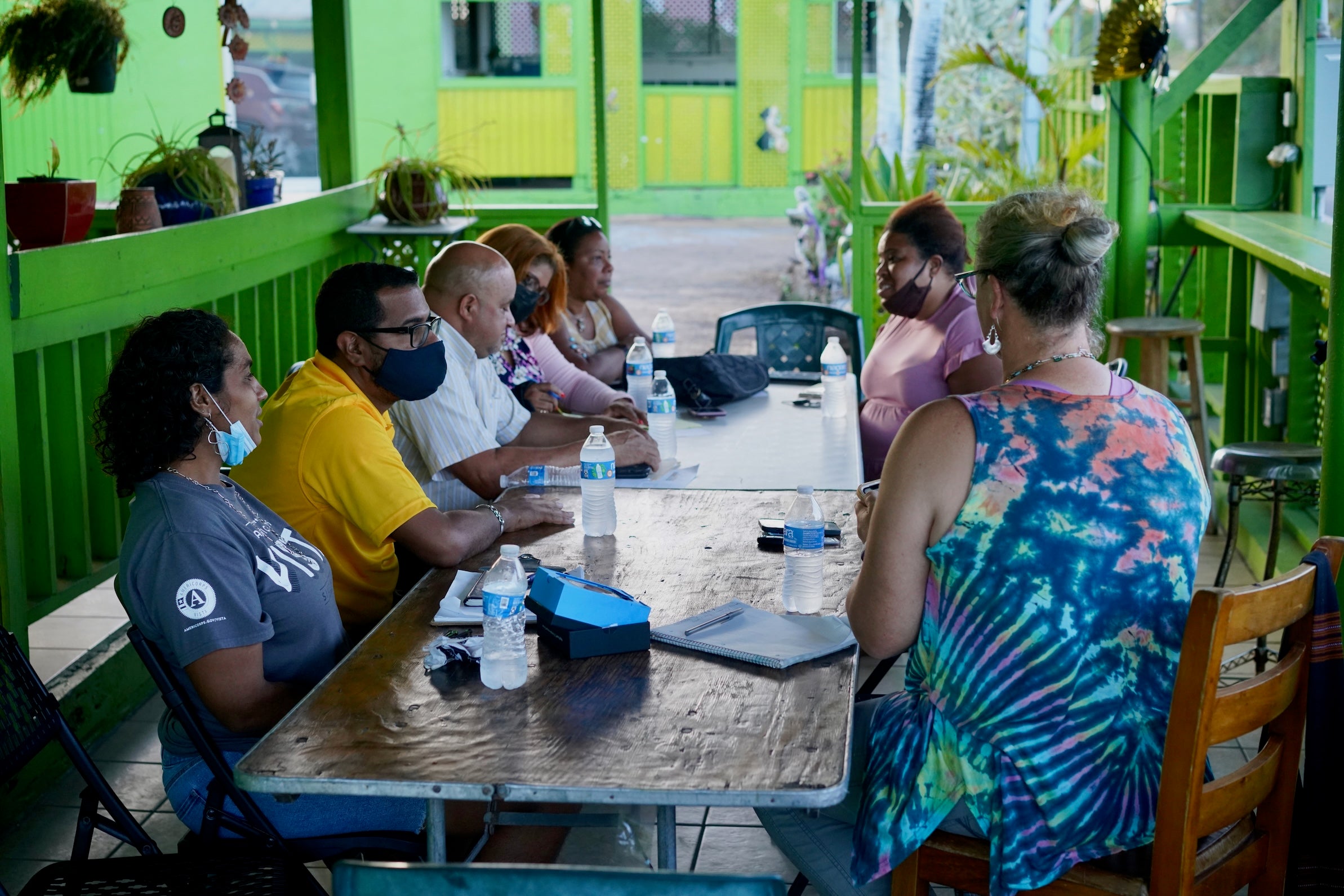
Surveying community members in Flamouyant in St. Croix, 2021. Photo: David Bond.
Although the Limetree shutdown is considered a major victory in environmental justice, for Bond, the work of addressing environmental justice is never complete. He sees his work as a living, ongoing effort and is eager to continue his collaborations while opening the door for new engagements. Working alongside collaborators, colleagues, and students, Bond is excited to be advancing the field and the mission of environmental justice at Georgetown.
“David is a fantastic choice to be Director of the Center for Environmental Justice,” says Dan Sulmasy, MD, PhD, Director of the Kennedy Institute of Ethics and current director of the Network. “His formal education is in cultural anthropology, yet his work is infused with a knowledge of ethics, philosophy, and science and technology studies. He has a broad vision, an engaging style, and an appreciation for the practical aspects of ethics, linking theory to action.”
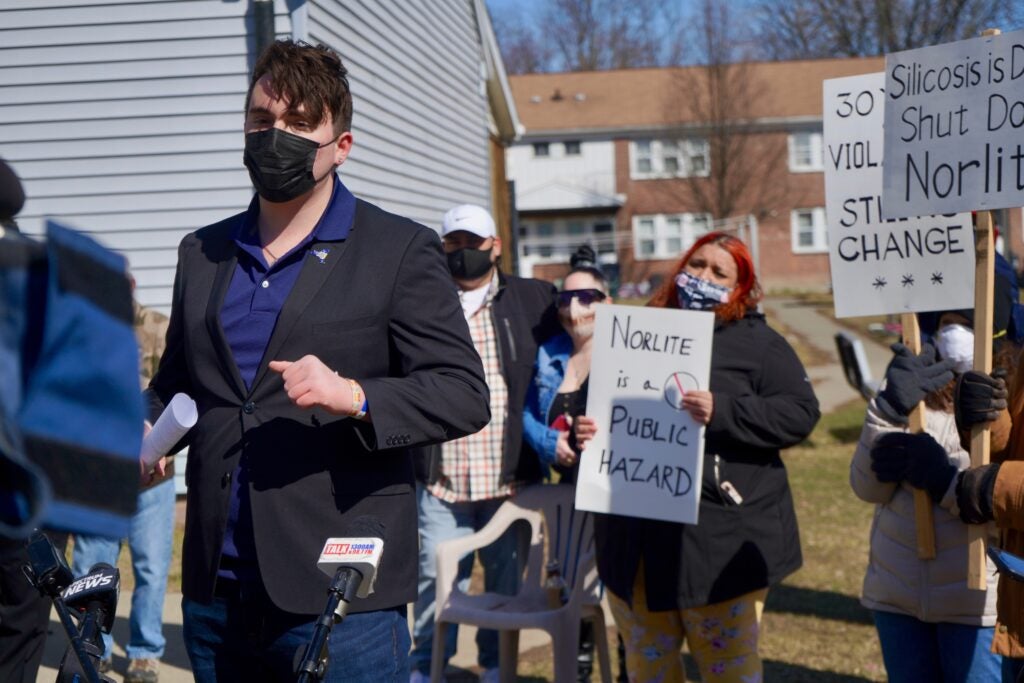
Norlite press conference at public housing next to hazordous waste incinerator in Cohoes, NY, in 2021. Photo: David Bond.
Respect for the kind of collaboration that Georgetown values—an openness to learning from each other and with the communities most affected by the challenges emerging at the faultlines of sociopolitical, economic, and philosophical worlds—drew Bond to Georgetown. “As others shy away from environmental justice, what an opportunity—and obligation—we at Georgetown have to take up the mantle of this vital work,” he says.